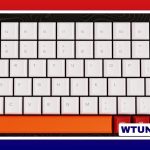
The number of keys on a keyboard affects much more than its size. It determines which functions are immediately available, how much desk space the board occupies, where your mouse sits, and how much you rely on shortcuts or programmable layers.
Keyboard sizes range from full-size models with a dedicated number pad to highly compact layouts that place several functions behind modifier keys. The best choice depends on what you do most often: entering numbers, writing, coding, gaming, editing, or working with creative software.
Common keyboard sizes and approximate key counts
Keyboard categories are usually described by their layout percentage or by their general key count. Exact totals vary between manufacturers, but the following groups provide a useful comparison:
- Full-size: Usually about 104 or 105 keys. These keyboards include the main typing area, function row, arrow and navigation keys, and a dedicated numeric keypad.
- Tenkeyless (TKL): Usually around 80 to 85 keys. A TKL board keeps the main typing and navigation sections but removes the number pad.
- 75 percent: Generally includes roughly 70 to 80 keys in a more compact arrangement. Navigation keys and the function row may be compressed or repositioned.
- 60 percent: Often has about 60 to 65 physical keys. It normally removes the dedicated function row, arrow keys, and navigation cluster, using layers instead.
- 40 percent: Usually has around 40 keys and depends heavily on combinations, layers, and programmable mappings.
These categories are not rigid standards. A keyboard may have a slightly different count while still being described as a 60 percent, 75 percent, or similar layout.
Why key count matters for everyday work
A larger keyboard gives more functions their own physical key. This can make editing, navigation, and shortcut-heavy applications easier because you do not need to remember as many key combinations. A full-size layout is especially convenient when a separate number pad is part of your routine.
A smaller keyboard reduces the distance between the typing area and the mouse. This can create a less crowded desk and may make it easier to keep the shoulders and arms in a more balanced position. Removing rarely used keys can also leave more room for mouse movement, which is one reason compact boards are popular for gaming.
The trade-off is that compact keyboards usually require more layers. Arrow keys, function-row commands, navigation controls, and sometimes numbers may be accessed by holding a modifier key. This can be efficient once learned, but it adds an adjustment period and may be inconvenient if you frequently use those functions.
Do you need a dedicated numeric keypad?
The numeric keypad is the clearest dividing line between full-size and smaller keyboards. Its calculator-style arrangement is useful for frequent numeric entry, particularly in accounting, finance, inventory work, spreadsheets, and other data-heavy tasks. A dedicated keypad can be faster and more comfortable than entering numbers from the top row.
If you only enter numbers occasionally, a built-in keypad may take up space without adding much value. Smaller keyboards can still provide number input through the top number row, a secondary layer, remapping, or an external numpad. Separating the keypad from the main keyboard also lets you move it out of the way when it is not needed.
Which layout fits different activities?
- Data entry and spreadsheets: A full-size keyboard is often the most convenient choice when numbers are entered constantly.
- Writing and general office work: Tenkeyless or 75 percent layouts retain familiar typing functions while using less desk space.
- Programming: TKL, 75 percent, and 60 percent boards can work well, but consider how often you use arrow keys, navigation keys, and function-row shortcuts.
- Gaming: Compact layouts can leave more room for mouse movement. The importance of dedicated keys depends on the games and shortcuts you use.
- Design, audio, and video work: A larger board or a programmable model may be useful when software relies on many shortcuts.
Programmable layers and custom layouts
A keyboard with fewer physical keys does not necessarily have fewer functions. Programmable firmware can assign alternate commands to layers, allowing one key to perform different actions depending on the modifier being held. Split and ergonomic keyboards may also use a reduced or unusual layout to prioritize hand position and comfort.
Layered layouts offer flexibility, but they require practice. Before choosing an extremely compact board, consider whether you are comfortable memorizing combinations and whether the keyboard can be configured to match your workflow.
How to choose your ideal number of keys
Start by identifying the keys you use repeatedly rather than choosing by percentage alone. Ask yourself:
- Do you enter numbers often enough to need a dedicated keypad?
- Would losing physical arrow or navigation keys slow you down?
- Would bringing the mouse closer improve your desk setup?
- Are you willing to learn layers or customize key mappings?
- Would an external numpad provide more flexibility than a full-size board?
If possible, try several layouts or temporarily remap keys to simulate a smaller board. The right number of keys is the one that supports your most frequent tasks without creating unnecessary reach, clutter, or shortcut memorization. For some users that means a full-size keyboard; for others, a compact or programmable layout provides the better balance of comfort and control.