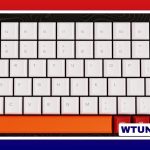
A 64-key keyboard offers a practical middle ground between a minimalist compact board and a larger tenkeyless model. It uses less desk space than a traditional keyboard while preserving more navigation functionality than many 60% layouts. For writers, programmers, gamers, students, and anyone working in a compact setup, this format can provide a useful balance of portability and everyday convenience. When choosing form factor, the compact 64-key layout offers a good balance between size and functionality.
What makes a 64-key keyboard different?
The 64-key label describes the approximate number of keys, not one universal arrangement. Different manufacturers and custom builders may place the arrow keys, navigation keys, modifiers, and function-layer controls in different positions. Some designs retain a familiar staggered layout, while others use a more compact or unconventional arrangement.
Many boards in this category include dedicated arrow keys and may provide access to Delete, Home, End, Page Up, or Page Down through either extra keys or a programmable layer. These additions can make text editing, spreadsheet work, and code navigation more comfortable than on a basic 60% keyboard, where nearly everything may depend on function combinations.
Advantages and trade-offs
The main benefit is efficient use of space. Removing the number pad and reducing the distance between the typing area and mouse can create a cleaner desk layout. A smaller board is also easier to carry between home, school, work, and travel locations.
However, compactness requires compromise. A 64-key keyboard may omit dedicated function-row keys, navigation buttons, or other controls found on larger models. Those commands might be accessed through a function layer, and learning their positions can take time. Layout differences can also make it difficult to move between keyboards without adjusting your muscle memory.
- Good for: smaller desks, portable setups, custom layouts, and users who value arrow keys without a full-size board.
- Less suitable for: heavy number-entry work, users who depend on a dedicated function row, or anyone who dislikes layered shortcuts.
Layout details to examine
Arrow and navigation keys
If you edit documents, work in spreadsheets, or navigate code frequently, check whether the arrow keys are dedicated and positioned comfortably. Also look at how Delete, Home, End, and Page Up or Page Down are handled. A layout that looks compact on paper may feel very different depending on whether these commands are immediately available or placed behind a modifier.
Modifiers and frequently used keys
Pay attention to the location and size of Shift, Control, Alt, Escape, and Backspace. Some compact designs replace or resize familiar keys to make room for arrows or additional controls. Programmers and power users should also consider how easily they can access symbols, brackets, and function-layer commands.
Keycap shape and spacing
Keycap profile affects both comfort and accuracy. Sculpted profiles give different rows distinct shapes, while uniform profiles use the same general shape across the board. Neither is automatically better; the important consideration is whether the profile and spacing feel natural during extended typing. Owners of a 64 Key Keyboard often prefer compact mode layouts for efficient desk setups and functionality.
Switches, keycaps, and construction
On a mechanical model, switches have the greatest effect on typing feel and sound. Linear switches provide a smooth press, tactile switches add a noticeable bump, and clicky switches produce an audible click as well as tactile feedback. If you are uncertain, testing a switch sampler or several keyboards can be more useful than choosing by description alone.
Hot-swap sockets are helpful if you expect to experiment with switches because they allow changes without soldering. Keycap material is another consideration. PBT is generally valued for durability and resistance to a glossy worn appearance, while ABS keycaps are available in many designs and can help keep costs down. Doubleshot and dye-sublimated legends are options to consider when long-term legibility matters.
For connectivity, wired USB-C provides a straightforward choice for a desk setup. Bluetooth can make a board easier to carry and use with multiple devices. A keyboard that supports both can offer reliable wired use at a desk while retaining wireless flexibility elsewhere.
Firmware and customization
Programmable firmware can make a compact keyboard far more capable. Depending on the board, systems such as QMK or VIA may let you create layers, remap keys, assign macros, and configure lighting. A function layer can provide access to a virtual function row, navigation cluster, media controls, or application-specific shortcuts without increasing the physical key count.
Customization should remain consistent and easy to remember. Begin with a simple layer for missing keys, then add macros only when they solve a genuine problem. A complicated arrangement may save keystrokes but create extra mental effort, especially when switching between devices.
Who should consider a 64-key keyboard?
- Writers and editors can gain more room for a mouse, notes, or other desk equipment while keeping useful navigation controls.
- Programmers may appreciate the compact footprint and the ability to place symbols and commands on custom layers.
- Gamers can free up mouse space while retaining arrow keys or programmable controls, depending on the layout.
- Students and travelers may find the format easier to carry than a larger mechanical keyboard.
- Creative professionals can use layers or macros for repetitive commands, especially when paired with a separate control device.
How to choose the right model
Start with the keys you use most often rather than choosing by appearance alone. Confirm the exact layout, inspect how navigation commands work, and decide whether you prefer dedicated keys or layers. Then compare switch type, keycap profile, hot-swap support, connectivity, build quality, and firmware options.
Finally, consider how much adjustment you are willing to make. A 64-key keyboard can be an excellent balance of size and functionality, but the best choice is the one whose layout feels predictable during your actual work. If possible, test the board or view a detailed keymap before buying, particularly when replacing a familiar full-size or tenkeyless keyboard.