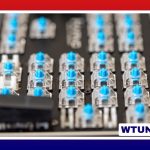
A split keyboard can make a noticeable difference to your typing posture without requiring a high-end custom build. By separating the left and right key clusters, it allows your hands and forearms to sit farther apart and gives you more freedom to position each side comfortably. For writers, programmers, students, and home-office users, an affordable split keyboard can be a practical way to explore ergonomic typing while keeping costs under control. Consider compact ergonomic layouts when choosing a cheap split keyboard to improve typing comfort and efficiency.
What makes a split keyboard different?
A conventional keyboard places both hands close together, which can encourage the wrists to bend outward while typing. A split design separates the keys into two sections, allowing each hand to line up more naturally with its forearm. You can adjust the distance and angle between the halves to suit your shoulders and desk.
The split itself is often the most important ergonomic feature. More expensive models may add tenting, premium materials, advanced firmware, or extensive customization, but an inexpensive board can still provide the basic posture change that makes the design appealing.
Choose the right layout and size
Affordable split keyboards come in several layouts. The best option depends on the keys you use regularly and how much desk space you have.
- Full-size: Includes a number pad, function row, navigation keys, and the standard number row. This is useful for frequent data entry but takes up more room.
- Tenkeyless: Removes the number pad while retaining most of the familiar layout. It is a practical compromise for general office work.
- 75% or compact layouts: Keep many standard keys in a smaller footprint, sometimes using tighter spacing or rearranged navigation keys.
- 60% layouts: Eliminate the function row and dedicated navigation cluster. These boards save space but usually require function layers for commands such as arrows, Home, or Delete.
- Columnar or ortholinear layouts: Arrange keys in straight columns rather than the staggered pattern found on most traditional keyboards. Some users find this reduces unnecessary finger movement, although it may take time to learn.
Also consider whether you want to remain with QWERTY or try an alternative such as Colemak or Dvorak. A programmable budget keyboard can make experimentation easier, but changing layouts introduces a learning period. Smaller boards may require frequent use of modifier layers, even if you keep QWERTY.
Where budget models usually compromise
A cheap split keyboard is unlikely to offer every feature found on a premium ergonomic or custom model. The case may use basic plastic, the keycaps may be difficult to replace, and the board may be sold with only one switch option. Some models have fixed switches rather than hot-swappable sockets, limiting your ability to change the typing feel later.
Wireless versions may provide straightforward Bluetooth connectivity without advanced multi-device controls. Wired USB models are often the simpler choice if the keyboard will remain at one desk. Tenting can also vary considerably: one board may include adjustable risers, while another may sit flat with no built-in angle adjustment.
These compromises do not automatically make a budget keyboard poor. Focus on the features that affect daily use most: dependable connections, consistent keys, comfortable spacing, and a case that does not flex excessively while typing. If compact ergonomics appeal to you, larger mechanical layouts offer more space and a bolder typing experience.
Features worth prioritising
When comparing inexpensive split designs, start with the fundamentals rather than decorative extras.
- Comfortable key feel: Look for consistent switches and stabilisers, especially on larger keys such as Space, Enter, and Backspace.
- Programmability: Remapping lets you move frequently used modifiers, shortcuts, or navigation keys closer to your strongest fingers.
- Layer support: Layers can restore missing function and navigation keys on compact layouts without adding physical keys.
- Replaceable parts: Hot-swappable switches, standard keycaps, detachable cables, and accessible replacement parts can extend the keyboard’s useful life.
- Connectivity that suits your desk: Choose wired USB for a straightforward stationary setup or Bluetooth if moving between devices is important.
Typing tests and user reviews can help you judge sound, key consistency, connection reliability, and overall construction. These details are difficult to evaluate from a product name or specification list alone.
Set up the keyboard gradually
Place each half so your forearms run in a reasonably straight line from your elbows to your hands. Keep your shoulders relaxed, then adjust the distance between the halves until the position feels natural. Avoid treating the keyboard as a fixed object; one advantage of a split design is that it can adapt to you.
If the board supports tenting, experiment with a modest angle rather than immediately using the highest setting. For a flat model, inexpensive risers can help you test a raised position, but make sure both halves remain stable. Keep the keyboard at a height that allows your wrists to stay comfortable rather than sharply bent.
Give yourself time to adapt. Start with shorter sessions and use the new keyboard for familiar tasks before relying on it for all-day work. If you customise layers or remap keys, make changes gradually so you do not create a confusing layout.
Is a cheap split keyboard a good starting point?
For many people, yes. An affordable split keyboard lets you test separated hand positioning, compact layouts, and programmable shortcuts without committing to an expensive custom setup. The main decision is not whether the board has every premium feature, but whether its layout, connectivity, and typing feel match your daily work.
Choose the smallest layout that still supports your regular tasks, prioritise reliable construction and useful remapping, and spend time adjusting the position of both halves. With those basics covered, a budget split keyboard can offer a more flexible and comfortable typing setup at a relatively modest cost.