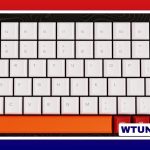
An 84-key mechanical keyboard is designed for people who want a smaller desk footprint without giving up the keys they use every day. It usually keeps the main typing area, a dedicated function row, arrow keys, and a navigation cluster while removing the separate numeric keypad found on full-size keyboards. The 84-key mechanical keyboard offers a compact form factor; explore mechanical keyboard layouts to compare sizes.
This makes the layout a useful middle ground. It is more accessible than a 60% or some 65% keyboard for users who rely on function and navigation keys, but it takes up less horizontal space than a traditional full-size or tenkeyless board.
What is an 84-key mechanical keyboard?
The term “84-key” describes the approximate number of physical keys rather than one completely standard layout. Many boards in this category use a compact arrangement similar to a 75% keyboard, with tightly spaced or rearranged navigation keys. Other designs may resemble a condensed tenkeyless keyboard.
Before buying, inspect the product photos and specifications rather than relying on the key count alone. The position of the right Shift, bottom-row modifiers, navigation keys, and spacing between key groups can vary between models. These differences affect typing comfort, keycap compatibility, and how quickly you adapt to the board.
How it compares with other keyboard sizes
- Full-size: Includes the main typing area, function row, navigation keys, and a dedicated number pad. It is useful for frequent numerical entry but needs the most desk space.
- Tenkeyless: Removes the number pad while generally preserving a familiar function row and navigation cluster. It is wider than many compact 84-key designs.
- 84-key or compact 75%: Retains many dedicated keys in a more tightly arranged footprint. It can leave extra room for a mouse, drawing tablet, or other desk equipment.
- 65%: Usually keeps arrow keys but omits the dedicated function row, which may place F-keys behind a function layer.
- 60%: Removes the function row, arrow keys, and navigation cluster from the primary layout, relying heavily on layers and shortcuts.
Why choose this layout?
An 84-key board can suit writers, programmers, office users, designers, and gamers who want dedicated controls without the width of a full-size keyboard. Function keys are convenient for software shortcuts and debugging, while arrow and navigation keys are useful for editing documents, moving through code, and controlling applications.
Gamers may also appreciate the additional mouse space created by removing the number pad. Writers and developers can keep familiar navigation controls close at hand instead of assigning them to a function layer. For users who find multi-key shortcuts difficult, a layout with more dedicated keys may also be easier to operate than a very compact keyboard.
Features to consider
Switch type
Mechanical switches are commonly grouped as linear, tactile, or clicky. Linear switches have a smooth press, tactile switches provide a noticeable bump, and clicky switches add a distinct sound and click response. Your choice should reflect typing feel, noise tolerance, and the environment where the keyboard will be used.
Hot-swap support
A hot-swappable circuit board allows compatible switches to be replaced without soldering. This is useful if you want to test different switch types or replace an individual switch later. A soldered board can still be durable and satisfying to use, but changing switches generally requires more work. Exploring split number pad layouts can help mechanical keyboard enthusiasts compare ergonomic options for extended typing sessions.
Programmability
Some keyboards let you remap keys, create layers, or assign macros. Firmware and software support varies, so check whether the board offers the configuration tools you prefer. Programmability can make it easier to adapt the keyboard for Windows, Mac, creative applications, or specialized shortcuts.
Wired and wireless connections
USB-C wired connections provide a straightforward setup. Bluetooth or other wireless options may be useful when switching between a desktop, laptop, and tablet. If wireless use matters to you, check the pairing process, number of supported devices, charging method, and whether the battery is replaceable.
Construction and acoustics
Cases may be made from lightweight plastic, aluminum, or other materials. Internal dampening, plate construction, stabilizers, and mounting design all influence sound and key feel. A heavier case can feel more planted, while a lighter board may be easier to carry.
Keycap compatibility and layout details
Compact layouts can use less common key sizes or positions, particularly on the bottom row and around the right Shift key. If you plan to customize the board, check the exact layout before purchasing keycaps. A standard keycap set may not include every size needed, or it may require additional compatibility keys.
Maintenance and upgrades
Mechanical keyboards can often be personalized over time. Common changes include replacing keycaps, changing hot-swappable switches, tuning or lubricating stabilizers, and adding case or plate dampening. Programmable boards can also be adjusted through remapping rather than physical modification.
For a first purchase, clear documentation, reliable software, and accessible replacement parts may be more valuable than extensive customization features. Also consider the warranty and the availability of layout-specific keycaps before committing to an unusual design.
Is an 84-key keyboard right for you?
Choose an 84-key mechanical keyboard if you want dedicated function and navigation keys but rarely need a numeric keypad. It is a practical compromise between convenience and desk space. If your work involves frequent data entry, a full-size keyboard or a separate number pad may be more suitable. If maximum portability and minimalism are the priority, a 60% or 65% layout may be a better fit.