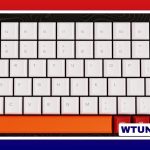
A mini keyboard with a number pad is designed for people who want efficient numeric entry without giving up valuable desk space. Standard full-size keyboards include a dedicated numeric section, but their width can leave less room for a mouse, documents, or other equipment. Compact alternatives aim to keep the number pad while reducing the overall footprint through narrower layouts, relocated navigation keys, or function-layer shortcuts. Explore compact layout options to see how a mini keyboard with number pad compares to standard sizes.
Why choose a compact keyboard with a number pad?
A dedicated numeric keypad is useful for spreadsheets, accounting tasks, inventory work, data entry, financial software, and any workflow involving frequent number input. Using the number row above the letter keys can be slower or less convenient when entering long sequences.
A smaller keyboard with a number pad can provide that same dedicated input area while fitting more comfortably on a compact desk. It may also leave additional room for mouse movement, which can be helpful for creative applications and gaming. A portable model can be paired with a laptop when the built-in keyboard is not practical for extended numeric work.
Understanding mini keyboard layouts
“Mini” does not describe one universal keyboard size. Compact keyboards with number pads use several different approaches to reduce width and depth:
- Condensed full layouts: These retain the letter keys, function row, arrow keys, navigation controls, and numeric keypad but reduce unused spacing and bezel area.
- Rearranged layouts: The navigation or arrow-key cluster may be moved, compressed, or positioned differently to make room for the number pad without using a full-size frame.
- Layered layouts: Some of the smallest models place navigation functions behind a function key. This saves space but requires additional key combinations for actions such as Home, End, or Page Up.
- Low-profile portable designs: These prioritize thinness and easy transport, often using scissor-style or other low-profile keys.
Before buying, examine the key arrangement rather than relying only on the product’s size label. Two keyboards described as compact may offer very different access to arrows, function keys, navigation controls, and the numeric block.
Wired or wireless?
Wired keyboards
A wired mini keyboard draws power through its USB connection, so there is no battery to recharge or replace. This makes it a straightforward choice for a permanent workstation or for users who prefer a direct connection. Cable placement is the main trade-off, particularly on a small desk or when connecting to a laptop with limited ports.
Wireless keyboards
Wireless models can create a cleaner workspace and are easier to move between locations. Bluetooth versions may be suitable for computers, tablets, and phones, while some keyboards offer switching between multiple paired devices. Check how device switching works before purchase and consider whether the keyboard remains usable while charging, if it includes a rechargeable battery. If you like a compact number pad, a compact dark layout can complement your workspace.
Features that affect comfort and usability
A small footprint does not automatically make a keyboard comfortable. Pay attention to the following details:
- Key feel: Scissor-style keys are often thin and quiet, while mechanical designs may provide more pronounced feedback. Choose based on your preferred typing feel and noise level.
- Key travel: Extremely shallow keys can be convenient for portability but may not suit users who prefer more physical feedback.
- Stability: A firm base and reliable rubber feet help prevent the keyboard from moving during rapid number entry.
- Number-pad arrangement: Confirm that the calculator-style layout and Num Lock behavior match your habits.
- Key remapping: Custom shortcuts can be useful when a compact layout places navigation or editing commands behind function layers.
- Build quality: A portable keyboard should withstand regular movement, especially if it will travel between home, office, and mobile devices.
Choosing the right size for your workflow
Start by deciding which keys you use every day. If the numeric keypad is essential but you also rely on dedicated arrows and navigation keys, choose a condensed layout that preserves those controls. If portability is more important, a smaller keyboard with layered functions may be worthwhile, provided you are comfortable using shortcuts.
Also consider how often the keyboard will move. A thin wireless model may be convenient for laptop use, while a more substantial wired or mechanical keyboard may be better for a fixed desk where typing comfort matters more than weight.
Setup and placement tips
Place the keyboard close enough that your elbows remain comfortably near your sides and your forearms stay roughly parallel with the desk. Keep the number pad accessible without forcing your wrist into an awkward angle. If you use a laptop, a compact keyboard can be positioned centrally while the laptop screen sits on a stand or to one side, depending on your workspace.
For Bluetooth models, pair each intended device and test the switching process before relying on it for work. For wired models, confirm that the computer has a suitable USB port; a compact hub may be useful with devices that have few available connections.
Final buying checklist
- Does the keyboard include a genuinely dedicated number pad?
- Are the arrow, function, and navigation keys arranged in a way you can use comfortably?
- Do you prefer wired simplicity or wireless flexibility?
- Are the key feel, travel, noise, and build quality suitable for long sessions?
- Will the keyboard fit your desk, laptop bag, and usual workspace?
The best mini keyboard with a number pad balances numeric productivity with the amount of space and portability you actually need. Comparing the layout, connection method, and typing experience is more useful than choosing by size alone.