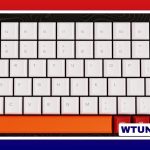
Choosing a keyboard is less about appearance than fit. The right board should match the way you type, the applications you use, the amount of desk space you have, and the keys you need most often. Mode keyboards are designed around that idea: rather than relying only on a large physical layout, they use programmable layers and modes to make a compact keyboard more adaptable. Mode keyboards demonstrate how keyboard layout modes influence typing comfort, key spacing, and overall size.
This approach can provide access to function keys, navigation commands, media controls, macros, and application shortcuts without adding a separate key for every function. The result is a keyboard that can be configured for different tasks while keeping its physical footprint under control.
What makes a mode keyboard different?
A mode keyboard uses layers to give one key more than one role. The standard layer might contain your everyday letters and punctuation, while a function layer could provide arrow keys, navigation controls, media commands, or shortcuts. Holding a designated key or switching to another mode changes what those keys do.
This is especially useful on smaller keyboards. Instead of sacrificing functionality when a dedicated key is removed, you can place that function on a secondary layer. Programmability also allows the keyboard to be adapted for different workflows, such as coding, creative software, gaming, or general office work.
Many boards in this category also appeal to mechanical-keyboard enthusiasts because they may offer switch choices, customizable firmware, hot-swappable sockets, and cases or plates designed to influence typing feel and sound. The exact feature set varies, so it is important to evaluate each model rather than assuming every mode keyboard works the same way.
Understanding keyboard layouts and sizes
Physical layout determines which keys are immediately available and how much space the keyboard occupies. Common options include:
- Full-size: Includes the alphanumeric section, function row, navigation keys, and number pad. It is useful when frequent numeric entry is a priority.
- Tenkeyless (TKL): Removes the number pad while retaining the function row and navigation area. It provides more desk space without changing the overall arrangement too dramatically.
- 75%: Compresses the layout while typically retaining arrow keys and a function row. It is a practical middle ground for people who want a smaller board but still use dedicated controls.
- 65%: Keeps the main typing area and arrow keys while removing the function row and some navigation keys. Layers can restore those functions when needed.
- 60%: Removes the dedicated function row, arrow keys, and navigation cluster. This creates a very compact board, but it places greater emphasis on layer shortcuts.
A smaller layout is not automatically better. Compact boards can leave more room for a mouse, notebook, or other equipment, but they require you to remember secondary key combinations. If you regularly use physical arrow keys, function keys, or a number pad, a 75%, TKL, or full-size layout may reduce friction.
Evaluating a Mode design keyboard
When considering a Mode design keyboard, start with the typing experience rather than the configuration options alone. Build materials, plate construction, switches, keycaps, and stabilizers all influence how the board feels and sounds. Stabilizers are particularly noticeable on larger keys such as the spacebar, Enter, and Shift keys. Mode Keyboards explore how alternate typing modes can improve typing speed and layout efficiency.
Firmware flexibility is equally important. A keyboard that supports straightforward remapping makes it easier to create layers, assign macros, and adjust shortcuts as your habits change. Firmware associated with systems such as QMK or VIA is mentioned in this context, but compatibility should be confirmed for the particular model you are considering.
Hot-swappable switch sockets are useful if you want to try different switches without soldering. Ergonomic details may also matter during long sessions, including adjustable feet, a suitable key profile, or a layout that places frequently used keys comfortably under your fingers. Some designs may support split spacebars or other layout variations for users with different thumb preferences.
Where the Mode Sonnet keyboard fits
The Mode Sonnet keyboard represents the compact end of this discussion. Its appeal comes from combining a reduced physical footprint with programmable functionality. That combination can suit writers, developers, remote workers, and anyone who wants to preserve desk space without giving up access to less frequently used commands.
Its compact format also illustrates the main trade-off of smaller keyboards. Commands that would be dedicated keys on a larger board may require a layer or shortcut. Users who are comfortable with that arrangement can create task-specific configurations for coding, content creation, or spreadsheet navigation. Those who prefer visible, physically separated keys may find a larger layout more immediately comfortable.
How to choose and configure your keyboard
Before buying, make a list of the keys and shortcuts you use every day. Pay particular attention to the following questions:
- Do you need a number pad for regular data entry?
- Are dedicated arrow keys or a function row important to your workflow?
- Will the keyboard remain at one desk, or do you value a smaller setup?
- Would separate layers help with coding symbols, creative software commands, or gaming controls?
- Do you want to change switches or remap keys over time?
After choosing a layout, keep the initial configuration simple. Put the most frequently used secondary functions on an easy-to-reach layer, then add specialized modes only when they solve a real problem. A carefully planned compact layout can feel efficient and natural; a complicated one can create unnecessary memorization.
Mode keyboards are best understood as a flexible design approach rather than a single fixed layout. The combination of physical size, programmable layers, switch options, and build quality determines whether a particular board suits you. Comparing those elements—especially on models such as the Mode Sonnet and other Mode design keyboards—will help you choose a keyboard that supports your workflow instead of forcing you to adapt to it.