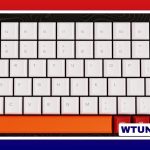
There is no single answer to how many keys a keyboard has. The total depends on the keyboard’s layout, size, region, and extra features. A conventional full-size desktop keyboard may have about 104 to 108 keys, while compact and specialty models can have considerably fewer—or, in the case of ergonomic split designs, more when both halves are counted. If you're counting keys, explore how different keyboard layouts change the number and arrangement of keys.
Common keyboard key counts
The following ranges cover several widely used keyboard formats:
- Full-size keyboard: Usually about 104 to 108 keys.
- Tenkeyless (TKL): Typically around 87 keys.
- 75% keyboard: Often has roughly 68 to 84 keys, depending on the design.
- 65% keyboard: Commonly contains about 65 to 68 keys.
- 60% keyboard: Usually has about 61 keys.
- 40% keyboard: May have around 40 keys and relies heavily on layers or shortcuts.
- Laptop keyboard: Often has approximately 78 to 80 keys, although the count varies by model and region.
These are useful guidelines rather than fixed standards. Manufacturers may add media buttons, macro keys, or other controls, so two keyboards described as the same size can still have different totals.
What is included on a full-size keyboard?
When most people picture a standard desktop keyboard, they are thinking of a full-size layout. It generally combines several sections:
- An alphanumeric area for letters, numbers, and punctuation
- Function keys from F1 through F12
- Arrow keys
- A navigation group containing keys such as Insert, Home, Page Up, Page Down, Delete, and End
- A dedicated numeric keypad
The commonly used Windows-oriented ANSI version is often described as having 104 keys. The ISO layout used in many European keyboards generally has 105 keys because of differences in the Enter key, left Shift key, and nearby key positions. Manufacturers may add volume controls, playback buttons, system keys, or macro controls, bringing some extended models to 106, 107, 108, or more keys.
Why compact keyboards have fewer keys
Compact keyboards reduce their physical size by removing or combining sections rather than eliminating every function. A tenkeyless keyboard, for example, removes the numeric keypad but keeps the main typing area, function row, arrows, and navigation keys. This produces a smaller board while preserving most desktop-keyboard functions.
A 75% keyboard condenses the layout and may keep the function row and a selection of navigation keys. A 65% keyboard normally keeps dedicated arrow keys but removes the function row. A 60% model usually removes the function row, navigation cluster, and numeric keypad as separate sections. Exploring bubble-shaped keys can add a playful perspective when counting keys across unusual keyboard layouts.
On these smaller boards, missing functions are commonly accessed through a function layer. Holding a designated key while pressing another key can produce an F-key command, navigation action, or other secondary function. The physical key count therefore does not represent every action the keyboard can perform.
Laptop, gaming, and specialty keyboards
Laptop keyboards are designed around limited space, portability, and a thin chassis. Many 13- to 15-inch laptops use layouts with around 78 to 80 keys, though larger models may include a numeric keypad and have a higher count. Regional layouts can also change the number and arrangement of keys.
Gaming keyboards may include dedicated macro keys, media controls, or additional system buttons. As a result, some have more than 110 physical keys. At the other end of the range, 40% keyboards use a very small number of keys and depend on custom layers, shortcuts, or alternative input methods.
Split ergonomic keyboards can make the count less straightforward. Each half may contain its own set of keys, so the total depends on whether you are counting one half or the complete keyboard. Custom mechanical keyboards can also use unusual layouts and programmable mappings that do not fit neatly into standard categories.
Which keyboard size is right for you?
Choose based on the keys and functions you actually use rather than the number alone:
- Choose full-size if you regularly enter numbers, use a numeric keypad, or want every major key group available.
- Choose TKL if you want a familiar desktop layout but do not need a dedicated number pad.
- Choose 75% or 65% if you want to save desk space while keeping important navigation keys.
- Choose 60% or smaller if portability, mouse space, or a minimalist setup matters more than dedicated keys.
- Choose an extended or programmable model if you rely on media controls, macros, or custom shortcuts.
In short, a keyboard can have roughly 40 keys, around 60 to 80 keys, approximately 87 keys, or more than 100 keys depending on its layout. To determine the exact number, identify the keyboard’s model and region, then count any additional controls included by the manufacturer.